


The Engine That Would Be Duke - Which Ffestiniog England Inspired Granpuff?


Twenty years ago, I met Doug, who quickly became one of my best friends as a result of shared interests, humour and a funny debate - which Ffestiniog George England did Awdry truly derive Duke the Lost Engine from?
FOUR LITTLE ENGINES

In 1863, the Ffestiniog Railway introduced steam traction to the railway to replace horsepower and increase efficiency when delivering empty slate wagons back to the Quarries at Blaenau Ffestiniog. The four little engines that arrived in Portmadoc that year were named Princess (1), Prince (2), Mountaineer (3) and Palmerston (4). They proved so successful that two larger versions were built in 1867 - Welsh Pony (5) and Little Giant (6).
However they became victims of their own success and the railway soon found they either needed to double the line or get a bigger engine. The first Double Fairlie locomotive, Little Wonder, was a triumph for the railway and more engines like it were built to replace the smaller England locos on the main line, whilst they were relegated to shunting at Portmadoc and Blaenau.

Today, four of the England engines survive. Princess hasn't been steamed since the 1940s, Welsh Pony returned to service in 2020 after having last saw duty in the mid 1930s, but Prince and Palmerston have been popular fixtures on the Ffestiniog roster. Poor Mountaineer was the first engine to be withdrawn from service in 1879, with Little Giant bowing out in 1929.
Awdry was clearly charmed by the little engines, and their influence is felt in Duke the Lost Engine in 1971. But while his narrow gauge companions on the Skarloey Railway have very direct ties to the individual Talyllyn engines, Duke is a little more ambiguous.
THE CASE FOR PRINCE

The most obvious example would have to be Prince. His name is the most similar to Duke, and he would have been in service and working order when Awdry was frequenting Wales in his lifetime. Awdry mentions the engine by name in the book's foreword and footnote, encouraging readers to visit the Ffestiniog Railway.
But Prince was never a lost engine. Far from it. When the Ffestiniog Railway was being revived in the 1950s, the old engine had a brand new boiler waiting to be placed on the frames to ready him for work again in the dawn of the preservation era.
A younger me argued that Prince was the influence behind Duke, but Doug made a compelling argument to the contrary...
THE CASE FOR PALMERSTON

Palmerston is by far the most travelled of his peers, having worked on the constructive of the North Wales Narrow Gauge Railway in the 1870s and being loaned out to help on the Vale of Rheidol many times between 1912 and 1922.
However in 1937, after receiving a modified version of Little Giant's boiler in 1932, he was withdrawn from service. In 1942, the engine became the stationary boiler at Boston Lodge Works and remained there until the railway closed. The stationary boiler is definitely something Awdry claimed for another engine from Duke the Lost Engine, Stanley the Baldwin, but whilst Stanley deserved his fate for a lifetime of bad running and poor behaviour, the railway's declining fortunes were the reason Palmerston was relegated.
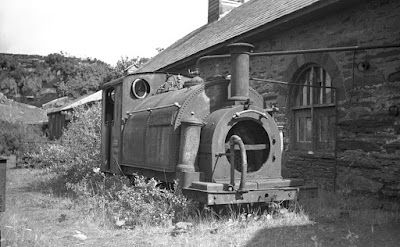
The engine remained in Boston Lodge yard for many years into the preservation era, and at the time Awdry was writing Duke the Lost Engine, it was considered beyond repair. Parts had been cannibalised to repair Prince and Palmerston was looking very sorry for himself - the likelihood was that he would become a lost engine.
However, he had a happy ending. He was bought and restored by an outside group and returned to steam in 1993, and later returned to Ffestiniog ownership.
THE CASE FOR MOUNTAINEER
I've since come to wonder if both Doug and I are wrong. Prince may have influenced the name, and Palmerston may have influenced part of the story, but could Mountaineer be the engine Duke was based on?

Historically, Mountaineer was the first engine to arrive on the Ffestiniog, and also the first to be withdrawn in 1879. In reality, the engine became a source of parts for the others. But in The Island of Sodor, Awdry states that Duke was built at Boston Lodge Works the same year for the Mid Sodor Railway. To my knowledge, the original Ffestiniog Railway company's Boston Lodge Works never built locomotives for other railways, much less railways of a different gauge (Ffestiniog is 2ft - Mid-Sodor was 2ft 3in). At the time, the works would have only recently completed Merridin Emrys, the first engine to be built in the newly expanded workshop facilities.
But given they had an engine going spare and the Mid Sodor was in need of one, it is plausible, and given the cost of the workshop expansion and cost of purchasing a "nearly new" locomotive, would be mutually beneficial to both parties... if it had occurred in reality! It's subtle, never directly mentioned, but it's a nice thought that Mountaineer got a new lease of life as Duke, or at least his surviving components would have. However, Mountaineer wouldn't have resembled Duke, particularly not in the way he was depicted in the illustrations.

At this point, the four original George England locos didn't look as they do now - they were originally designed with sidetanks, being rebuilt with saddle tanks and cabs came around 1889 with Palmerston. The "large" Englands, Little Giant and Welsh Pony were built with saddle tanks from the outset. Being the improved version, likely they probably would have been the influence behind the newly built Duke when he was under construction at Boston Lodge. Given Mountaineer's withdrawal and scrapping, he would have remained a uncabbed sidetank engine for the duration of his lifespan.
With only a paragraph of Duke's earliest history documented, it's difficult to glean these parts of the story, and Awdry provided no direct evidence to confirm whether or not it's coincidental or if they're direct hints / clues. Similarly, Mountaineer's withdrawal and scrapping remain shrouded in mystery also, there's no documentation to explain definitively why the engine was withdrawn, but the engine was used as a source of parts for the other Englands.
HAVE WE FOUND OUR DUKE?

It's fun to speculate over, but I can't help but feel that Duke is a mix of the three engines above. Prince's name, Palmerston's woes and Mountaineer's sacrifice. The case for Palmerston got a shot in the arm when he was dressed up as Duke for the Ffestiniog's long since discontinued Friends of Thomas events, but that's by the by.
DUKE TODAY
All in all, despite only having limited appearances, old Granpuff remains a firm favourite, no matter who inspired him. The character model from the television series was reproduced by Kato Model Railways in Japan as a limited edition 009 gauge engine, and he was represented at the 2025 Awdry Extravaganza Event at the Talyllyn Railway by Palmerston again!


Comments